Video link
Embedded video, just below:
Transcript: Dr. Andrew Bostom Interviewed by Hugh Hewitt, 11/24/26
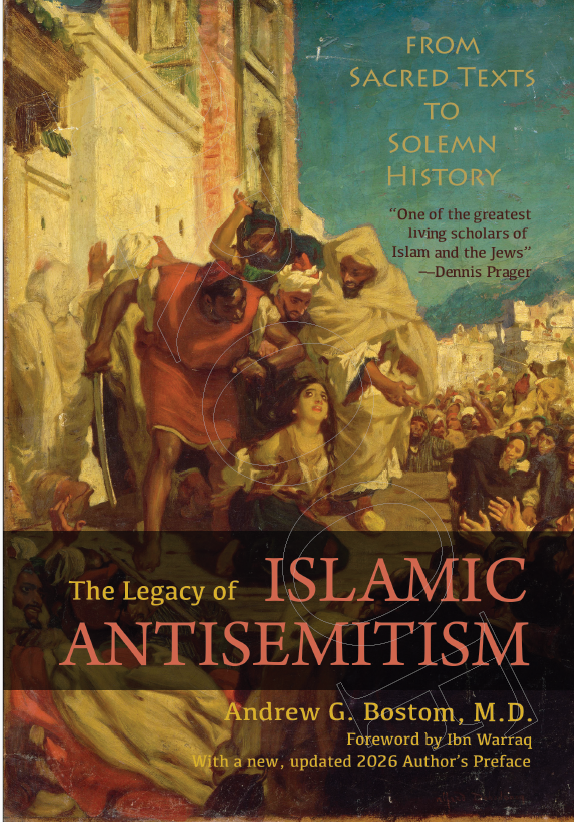
(Hugh Hewitt): Dr. Andrew Bostom. Dr. Bostom has been endorsed by our friend Dennis Prager, by Victor Davis Hanson, by a number of people. He’s one of the leading authorities on the sources of Antisemitism within Islam. He’s the author of this book, The Legacy of Antisemitism, of Islamic Antisemitism. This smaller book, “The Mufti’s Islamic Jew Hatred,” this one is just a pamphlet, and I think pretty much anyone who knows anything knows that the Mufti was antisemitic and wanted Hitler to succeed in the final solution. But Dr. Bostom, welcome. Why have you devoted so much of your life to this?
(Andrew Bostom): I think that when I began studying Islam, it’s really been the 25 years since 9-11. One of the fundamental misconceptions was the notion of Islamic Antisemitism as somehow a borrowed phenomenon. In other words, there weren’t intrinsic sources, profound intrinsic sources, of Antisemitism within Islam’s canon, within its history. But for the influence of European ideologies, medieval Christian antisemitic motifs, themes from the protocols of the Elders of Zion, obviously Nazism, there would be no Antisemitism in the Muslim world. That’s a profoundly flawed conception.
(Hewitt): Now, I’ve got a lot of Muslim friends. They’re not antisemitic. And as a Catholic, I realize that my church, from the medieval time until well into the 20th century, had a deep, deep strain of Antisemitism. Is there a branch, is there a division, as I believe there is within Islam, between those who are not antisemitic and those Islamists who are deeply antisemitic?
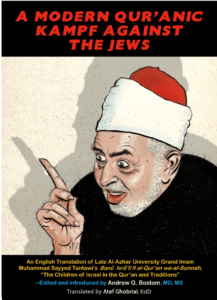
(Bostom): The problem is that the authoritative institutions of Islam, for example, that’s why I did a recent study of late Grand Imam Tantawi of Al-Azhar University, the authoritative institutions are themselves profoundly antisemitic. And these materials which they gather from Islam’s canon, from the Quran, from the traditions of Muhammad, and they interpret in the modern era in a way that’s no different than the classical exegetes [Qur’anic commentators] of the past. And they disseminate this across the Muslim world. It’s unfortunately resonating in our era. And we have the polling data to show this to you. I mean, the ADL [Anti-Defamation League] has created a very simple instrument to gauge what they call extreme Antisemitism. They present a respondent with 11 antisemitic stereotypes. And if the respondent agrees with at least six of them, they become an index case of extreme Antisemitism. And then the ADL just tallies the prevalence of this degree of Antisemitism in nation states, within nation states, etc. So when they’ve done their last two global surveys of over 100 countries, in 2014, the 16 most antisemitic countries in the world were all Muslim societies, where the prevalence of this degree of extreme Antisemitism was anywhere from about 70 to 93 percent. In 2024, they repeated the survey. And now it was the 19 most antisemitic countries in the world were all Muslim societies, where the prevalence of this degree of Antisemitism, again, extreme Antisemitism, was anywhere from 64 to 97 percent. And this travels, unfortunately, with the diaspora communities from the Muslim world, so that Muslims of Western Europe, again, on the same scale, are anywhere from two to fourfold more extremely antisemitic than their non-Muslim counterparts in Western Europe. And in the United States, even, the only data that the ADL ever produced, although it was published by an academic, not by them, showed that 38 percent of U.S. Muslims were extremely antisemitic versus only six percent of non-Muslims. And those data are dated. They’re from about 2017 now.
(Hewitt): So, Dr. Bostom, coming at it from the other side, what is the best news for anyone studying the Muslim community in the United States, in Europe, and then in Islamic countries? What percentage of Muslims are not antisemitic in the United States?
(Bostom): Again, what ADL gauges is extreme Antisemitism. What they’re not telling you is the prevalence of milder forms of Antisemitism. But if we just use the extreme Antisemitism as a number, it would say that, you know, half the Muslims in the United States, certainly by now, are probably not extremely antisemitic. I mean, that would be sort of the silver lining, I guess, if you want to call it that.
(Hewitt): Well, that’s what I wanted to get to, is that I don’t want people walking around giving a life force to the idea that every Muslim hates Jews, because I don’t think that way lies any progress. I do think we ought to find, and Alex Haley used to say, find the good and praise it. I’ve got a lot of friends who just are repulsed in the Muslim community, who are repulsed by Antisemitism. But then I come to this book, From Sacred Text to Solemn History, The Legacy of Islamic Antisemitism. It’s your 2026 updated book. And it’s got, you know, Stephen Katz from the Wiesel Center. Martin Gilbert is an endorser of yours. Victor Davis Hanson is an endorser of yours. Why so much time, Andrew? And I know you and I share knowledge of the Trager tragedy, which is an antisemitic tragedy, worked upon then by a Muslim extremist, I think, that’s my view. Why have you supported so much, devoted so much of your life to it?
(Bostom): Again, I thank you, because people are not dealing with the source material, and they’re not dealing with the institutions. And I think this is critical. You know, in the post-October 7th era, the Middle East Media Research Institute commissioned, actually it was a Muslim, to survey U.S. mosques. And he went through a couple of hundred sermons in the period after October 7th. And he could not find a single, you know, confessional about the repulsive nature of the Hamas carnage on October 7th. And the Antisemitism that was preached in U.S. mosques mimicked the, you know, the themes that are preached in the Middle East, Jews as corruptors [Qur’an 5:64] , Jews as killers of prophets [Qur’an 2:61; 3:112, others]. And these themes are being preached in our own backyard. I wound up investigating a local mosque here in Providence, in Rhode Island. And again, the same themes were being reiterated. Now, does it resonate with all Muslims? You know, obviously not. But I think we need to be much more forceful in using the bully pulpit to condemn this kind of preaching, which is rampant across the United States.
(Hewitt): Dr. Andrew Bostom, thank you for your, I mean, it’s really an admirable amount of scholarship on your part. As Eric Trager said, thank you for sending it to me. Thank you for talking about it with me. Have a good Thanksgiving, Dr. Bostom.
(Bostom): Thank-you.
Andrew Bostom

Andrew G. Bostom is the author of The Legacy of Jihad (Prometheus, 2005) and The Legacy of Islamic Antisemitism " (Prometheus, November, 2008) You can contact Dr. Bostom at @andrewbostom.net