(*Forme Fruste per Merriam Webster: “an atypical and usually incomplete manifestation of a disease”)
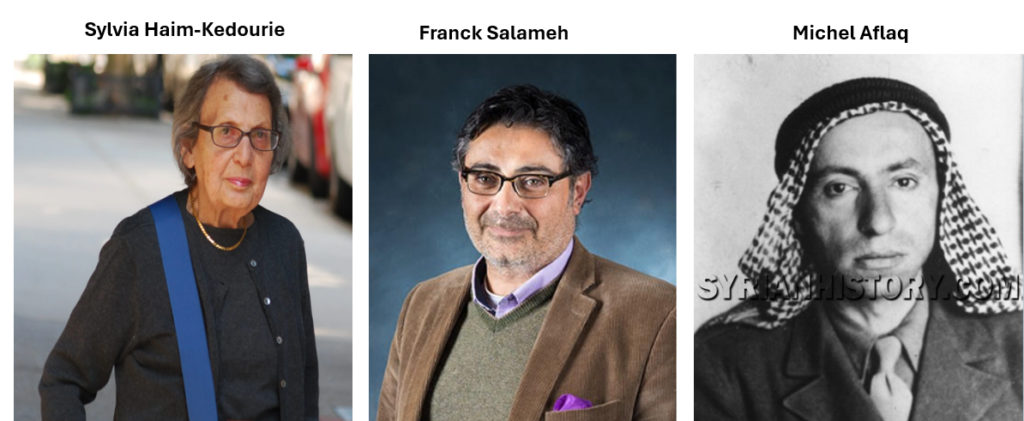
Sylvia Haim (Kedourie) one of the most esteemed 20th century scholars of so-called “secular” Arab nationalism long ago demonstrated that this ideology was in fact another expression of Islam’s sine qua non institution, the jihad. Haim wrote in her 1955 essay, “Islam and the Theory of Arab Nationalism,”
… “Another feature of the modern doctrine which fits in with the Muslim past is the emphasis which both of them lay on communal solidarity, discipline and cooperation. The umma in Islam is a solidary entity, and its foremost duty is to answer the call of the jihad [emphasis added]. This brings us to the third feature which both modern and ancient systems have in common, to wit the glorification of one’s own group. The traditional attitude of the Muslims to the outside world is one of superiority, and the distinction between the Dar al-harb, Dar al-Islam, and Dar as-sulh, is an ever present one in the mind of the Muslim jurist. It may therefore be said in conclusion of this modern doctrine of nationalism, that although it introduces into Islam features which may not accord with strict orthodoxy, it is the least incompatible perhaps of modern European doctrines with the political thought and political experience of Sunni Islam [emphasis added].
Haim-Kedourie added in her 1962 “Arab nationalism: an anthology,” that the founder of the Arab Nationalist Ba’ath Party, Michel Aflaq had stated quite plainly:
“Muhammad was the epitome of all the Arabs, so let all the Arabs today be Muhammad. . . . Islam was an Arab movement and its meaning was the renewal of Arabism and its maturity . . . [even]Arab Christians will recognize that Islam constitutes for them a national culture in which they must immerse themselves so that they may understand and love it, and so that they may preserve Islam as they would preserve the most precious element in their Arabism.”
And Haim concluded, “ For Aflaq, Islam is [emphasis in original] Arab nationalism.”
Indeed Dr. Franck Salameh reminded us that Arab nationalist par excellence Michel Aflaq himself is reported to have stated over and again that “Islam is to Arabism what bones are to the flesh,” (Michel Aflaq, Fī Sabīl al-Baʿath [For the Sake of the Ba’ath] (Beirut: Dār al-Ṭalīʿah, 1959), 43, 68. Another version of this adage Salameh notes, is “Arabism is a body whose soul is Islam.”)
Andrew Bostom

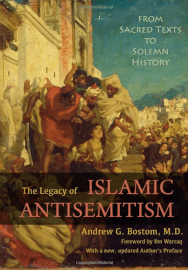
Andrew G. Bostom is the author of The Legacy of Jihad (Prometheus, 2005) and The Legacy of Islamic Antisemitism " (Prometheus, November, 2008) You can contact Dr. Bostom at @andrewbostom.net