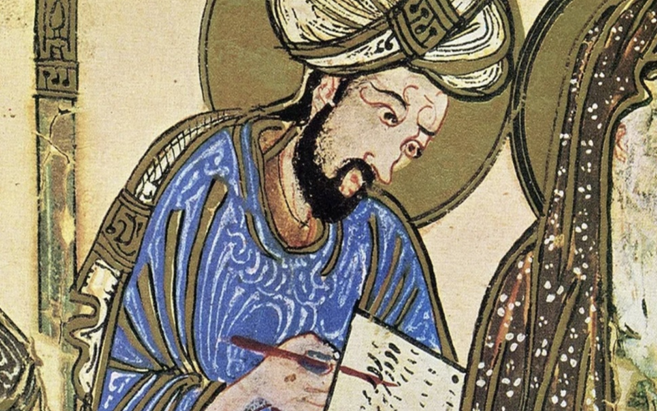
Reynolds A Nicholson (d. 1945) was deemed England’s most authoritative scholar of Islamic mysticism. In Nicholson’s A Literary History of the Arabs, we are told (p. 492) Ibn al-Arabi (d. 1240), Islam’s “Greatest Sufi Master” (“Sheikh al-Akbar” among Sufis), although insistent “on punctilious observance of Islamic law (Sharia),” somehow, “curiously enough,” combined that “straightest orthodoxy” with “the most extravagant mysticism.”
Ibn Arabi’s “most extravagant” and indeed remarkably ecumenical sounding mysticism was exemplified in these famous lines (p. 492):
“My heart is capable of every form:/ A cloister for the monk, a fane [church] for idols,/ A pasture for gazelles, the votary’s Ka’ba,/ The tables of the Torah, the Qur’an./ Love is the creed I hold: wherever turn/ His camels, Love is still my creed and faith.”
Despite such ruminations, Janus-faced Ibn Arabi’s real world strict Sharia-compliant orthodoxy advocated harsh imposition of Islam’s bigoted and oppressive “stipulations” on non-Muslim dhimmis (Jews, Christians, and Zoroastrians) subjugated by jihad, as rooted in the classical interpretation of Qur’an 9:29, and the corollary edict of Islam’s second “Rightly Guided” Caliph Umar b. al-Khattab.
What follows is the advice on the treatment of non-Muslim dhimmis (especially Christians) Ibn Arabi wrote to the Seljuk Turkish Muslim ruler of Konya (in Asia Minor; from 1211-1220) Kaykaus I after sojourning in his realm, as recorded in the “Greatest Sufi Master’s, magnum opus al-Futuhat al-Makkiyya (“The Meccan Revelations” or “The Meccan Openings”). The peripatetic Ibn Arabi, who after passing through Konya had gone on to Baghdad, was responding to a letter Kaykaus had written to him asking how the sultan should treat his numerous Christian subjects. The translation below was made by late Italian scholar (died April 27, 2026) Giuseppe Scattolin and published in his 1998 essay, “Sufism and Law in Islam: A Text of Ibn Arabi (d. 1240) on ‘Protected People’ (Ahl- Al-Dhimma),” Islamochristiana vol. 24. 1998, pp. 37-55, p. 45:
“[S]tipulations established by the prince of the believers Umar b. al-Khattab—may Allah be pleased with him—concerning the protected people (ahl al-dhimma). Namely that: ‘They shall not build new churches or convents or hermitages (for monks) in their towns and the countryside around. They shall not renew those (of these places) that fall in ruins. They shall not hinder (the use) of their churches to Muslims to stay there for three nights, giving them food. They shall not give shelter to spies, neither shall they hide from Muslims any plot against them. They shall not teach their children the Qur’an. They shall not show (the signs of) their associationism (a reference to the Christian Trinity), neither shall they forbid their relatives from embracing Islam, if they so wish. They shall respect Muslims and stand up from their seats whenever they (Muslims) want to sit. They shall not try to resemble Muslims in anything as regards clothes, hat, turban, sandals and the way of combing. They shall not take names or titles of Muslims. They shall not ride on saddle, neither shall they gird themselves with swords or possess any other kind of weapon. They shall not engrave their ring seals with Arabic letters, and they shall not sell spirits. They shall clip their forelocks; they shall their way of dressing everywhere: so they shall gird themselves with a belt (zunnar) around their waist. They shall not show either their crosses or their books on the ways used by Muslims. They shall not bury their dead near those of the Muslims. They shall not strike their bells (hard) but only very gently, neither shall they raise their voices while reading in their churches in the presence of Muslims (i.e., near Muslims). They shall not go out wandering around (or better in processions). They shall not raise their voices accompanying their dead (for burial) neither shall they light fire while doing this. They shall not buy slaves that have been allotted to Muslims. Should they infringe anything of the stipulations imposed on them, they will have no right to protection (dhimma); in that case it is lawful for Muslims to treat them as rebellious and seditious people (i.e., the jihad against them may be renewed).’ This is the text (of the stipulations) written by Umar b. al-Khattab—may Allah be pleased with him. Besides it is al so a sound tradition of the Apostle of Allah—may Allah give him blessing and peace—that he said: ‘No church shall be built in Islam, and no church falling in ruins will be renewed.’”
As historian Speros Vryonis observed in his magisterial, The Decline of Medieval Hellenism in Asia Minor and the Process of Islamization from the Eleventh through the Fifteenth Century, “The harsh counsel al-Arabi gave amounted to heavy oppression.” Vryonis elaborates:
“There seems to be no doubt that from the beginning of the fourteenth century certain restrictions attributed to Umar were being applied to the Christians of Anatolia in regard to dress. Karim al-Din Mahmud, a contemporary of the events he describes, relates that the [Islamized] Mongol governor of Anatolia, Timurtash (d. 1328), found the clothing and hats of the Jews and Christians to be indistinguishable from those of the Muslims. He announced that the non-Muslims should wear conical hats with yellow turbans so that they could be distinguished from the faithful, for, he continued, it would exalt Islam and abase the infidel. Karim al-Din noted that the Mongol governor was thus conforming to the advice the great sheikh Ibn Arabi had given the sultan Kaykaus I…[T]he advice al-Arabi had given to Kaykaus I…many years later Timurtash applied, at least in part. Karim al-Din informs the reader that it is absolutely essential to follow the advice al-Arabi has given.”
The Seljuk and Ottoman jihad campaigns from the 11th through 15th centuries, which ravaged and ultimately destroyed Christian Asia Minor, were spearheaded by ‘Ghazi’ (from the word Ghazwa or ‘razzia’) movements, ‘Warriors of the Faith’, brought together under the banner of Islam to fight infidels, and obtain booty. Incited by pious Muslim theologians—most prominently, Sufi dervishes—these ghazis were at the vanguard of both the Seljuk and Ottoman jihad conquests. Historian A.E. Vacalopoulos highlighted the role of these dervishes during the Ottoman campaigns (p. 66):
“…fanatical dervishes and other devout Muslim leaders…constantly toiled for the dissemination of Islam. They had done so from the very beginning of the Ottoman state and had played an important part in the consolidation and extension of Islam. These dervishes were particularly active in the uninhabited frontier regions of the east. Here they settled down with their families, attracted other settlers, and thus became the virtual founders of whole new villages, whose inhabitants invariably exhibited the same qualities of deep religious fervor. From places such as these, the dervishes or their agents would emerge to take part in new military enterprises for the extension of the Islamic state. In return, the state granted them land and privileges under a generous prescription which required only that the land be cultivated and communications secured.”
A consistent 2006 analysis of Sufi-fomented religious violence in 14th and early 15th century Mamluk Egypt noted while hagiographic sources often invoked “the piety of a Sufi shaykh using the trope of dhimmis converting at his hands,” other historical evidence revealed “sufi-led violence against dhimmi property had more immediate and enduring effects in terms of religious conversion,” and that “church destruction was a topos (traditional theme) of piety in its own right.”
Finally, Scattolin’s commentary on his translation of Ibn Arabi’s advice on the treatment of dhimmis included these sobering observations. Conceding Ibn Arabi’s “Sufi vision” was “a most impressive achievement of Islamic mystical thought,” he decried how “such a vision” was “still based on a quite reductive and ideological approach to other religions,” a bigoted mindset whose severe limits had to be transcended. Scattolin concluded that even Ibn Arabi’s much ballyhooed “mystical” Islam could not “afford to avoid the arduous and painstaking ‘crux’ of an enlightened criticism.”
Andrew Bostom

Andrew G. Bostom is the author of The Legacy of Jihad (Prometheus, 2005) and The Legacy of Islamic Antisemitism " (Prometheus, November, 2008) You can contact Dr. Bostom at @andrewbostom.net