The X-account of Al-Azhar University, Sunni Islam’s most important near Vatican-equivalent religious teaching institution since the 13th century, posted the following on March 18, 2026:
“12 years old…Surah Al-Fatiha recited by a prodigy from the prodigies of Al-Azhar’s Quranic reciters, Omar Ali, a first-year preparatory student at the Azharite school, the rising star in the sky of Egyptian recitation, and the youngest to lead the worshippers in prayer at Al-Azhar Mosque during the month of Ramadan.”
Here is the video of his recitation:
Islam’s prophet Muhammad explained to one of his early followers that this brief opening sura (chapter) of the Qur’an (sura “Al-Fatiha,” “The Opening,” chapter 1/sura 1, [verses 1–2–3–4–5–6–7]) was the “greatest sura in the Qur’an.” Here is that tradition, Sahih al-Bukhari 5006:
“Narrated Abu Sa`id Al-Mu’alla: While I was praying, the Prophet called me but I did not respond to his call. Later I said, “O Allah’s Apostle! I was praying.” He said, “Didn’t Allah say: ‘O you who believe! Give your response to Allah (by obeying Him) and to His Apostle when he calls you’?” (Qur’an 8:24) He then said, ‘Shall I not teach you the greatest Surah in the Qur’an?’ He said, ‘(It is), ‘Praise be to Allah, the Lord of the worlds. ‘ (i.e., Surat Al-Fatiha) which consists of seven repeatedly recited Verses and the Magnificent Qur’an which was given to me.’”
Another canonical tradition of Muhammad (Sahih Muslim 394A) instructs Muslims,
“It Is Obligatory to Recite Al-Fatiha in Every Rak’ah; He who does not recite Fatiha al-Kitab is not credited with having observed the prayer.”
There are 17 total units of prayer (rak’ahs) in the mandated 5 daily Muslim prayer sessions, hence all 7 short verses of the Fatiha are repeated 17 times daily by pious Muslims.
Muslims are directed on their appropriate, righteous path, i.e., Islam, by “merciful Allah”, as set forth in the fatiha’s initial 6 verses (1:1,2,3,4,5,6), but they are cautioned, sternly, at concluding verse 7:
“The path of those upon whom You have bestowed favor [Islam], not of those who have evoked [Your] anger or of those who are astray’,
Muhammad, in yet another canonical tradition clarified plainly, for Muslims, it is the Jews who evoked Allah’s anger, and the Christians who went astray. This clarifying interpretation is reinforced with rare exceptions by over thirteen centuries of authoritative classical and modern Qur’anic commentaries which have glossed verse 1:7.
The Qur’an: An Encyclopedia is a modern compendium of analyses written by 43 Muslim and non-Muslim mainstream academic experts, edited by Oliver Leaman, and published by Routledge, New York, 2006. These excerpts from p. 614 serve as a “summary verdict”—consistent will all the previous evidence marshalled—on how Muslims and non-Muslims, both, are to understand the Fatiha’s last verse:
The Prophet [Muhammad] interpreted those who incurred God’s wrath as the Jews and the misguided as the Christians. The Jews, we are told killed many of their prophets and through their character and materialistic tendencies [usurious 2:275, 4:161; greedy/hedonistic 2:96; envious 2:109; hard-hearted 2:74; liars 2:78] have contributed much to moral corruption, social upheaval and sedition in the world [Koran 5:32–33; 5:64] …[T]hey were readily misled and incurred both God’s wrath and ignominy [2:61; 2:90; 3:112]. As for the Christians…over time they succumbed to the influence of those who had already deviated from the chosen path. (5:77)
Dissenting glosses on Qur’an 1:7 certainly do exist, but they remain marginal. The gloss of “modernist” Muhammad Abduh (d. 1905), is perhaps most often touted—at present—as representing this ostensibly more “ecumenical” interpretation of Qur’an 1:7. Rather ironically, Abduh’s disciple, and collaborator on the Qur’anic commentary, Rashid Rida (d. 1935), contradicted his mentor’s gloss, in favor of the standard hateful interpretation!
Irrefragable evidence of the vast majority consensus interpretation of the Fatiha’s last verse, was compiled in a 2014 monograph that analyzed 87 authoritative Sunni and Shiite Qur’anic commentaries available at the esteemed Muslim website AlTafsir.com. The glosses on Qur’an 1:7 spanned the 8th century through the early 21st, and the analysis described how 10 of the 13 Shiite commentaries, and 68 of the 74 Sunni commentaries, i.e., 78 of the 87, total, provided glosses maintaining the Jews incurred Allah’s anger, and the Christians went astray. Of the eleven most recent commentaries whose authors were alive into the 21st century, ten reiterated this still predominant, traditional gloss on Qur’an 1:7.
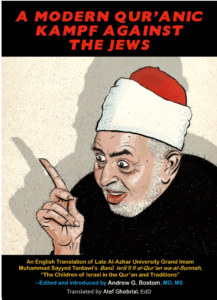
Late Al-Azhar University Grand Imam and a pre-eminent contemporary Sunni Qur’anic commentator, Muhammad Sayyed Tantawi was one of the 10/11 modern sages whose commentary reiterated Muhammad’s traditional understanding of Qur’an 1:7, stating:
“Those who have incurred Allah’s anger are the Jews, and those who are misguided are the Christians. This interpretation comes from Muhammad, in a tradition narrated by Imam Ahmad (ibn Hanbal) in his Musnad and Ibn Habban (al-Busti) in his Sahih. Some exegetes [commentators] say those who have incurred Allah’s anger [the Jews] knew the truth, but departed from it out of stubbornness and denial. As for the misguided [the Christians], they are those who lack knowledge, and remain in error without finding the straight path.”
The deleterious impact of such daily repeated negative indoctrination about Jews and Christians can only engender hateful, disparaging Muslim attitudes towards them. Taking advantage of the complete lack of understanding of any potential non-Muslim onlookers, such hateful indoctrination directed at Muslims was on proud, ostentatious display—through the incantation of a 12-year-old “prodigy”—at Al-Azhar University’s mosque on March 18, 2026.