(Note: This is a 1600-word summary of a detailed ~8300-word essay. The full evidence — including the Qur’anic passages, classical jurists, historical records and extensive extracts from Al-Azhar commentaries and pronouncements — is set out in that much longer, fully annotated essay.)
***
There is nothing inherently objectionable about frank, honest Jewish-Muslim dialogue. Nor is there anything wrong with pointing out that religious texts have contexts, histories and competing interpretations. Quite the opposite. However, “context” should illuminate difficult material, not make it disappear.
The basic problem with Rick Sopher’s increasingly prominent campaign against what he calls “Quranophobia” is its lack of Qur’anic candor. Sopher is a banker turned self-described interfaith activist, not a Qur’anic scholar. His new collaborative book, Illuminating Scriptural Connections, draws parallels between Jewish and Islamic scripture, and his argument has been warmly received in parts of the Jewish press. Sopher’s underlying thesis is remarkably simple. In a lecture at the ISGAP Summer Institute this July, Sopher went so far as to suggest that “the Qur’an just wants Jews to be better Jews.”
Sopher’s claim is striking. It is also impossible to reconcile with the Qur’an itself, with centuries of Muslim commentary on Islam’s central text, and — most importantly — with the teachings of the very Islamic institution Sopher cites as evidence for his optimistic assessment. That institution is Al-Azhar University in Cairo.
Al-Azhar is not some provincial seminary or eccentric “radical” Islamic fringe group. Founded more than a thousand years ago, it is one of the most prestigious centers of Sunni Islamic learning in the world. Its Grand Imam occupies an unusually authoritative position in contemporary Sunni Islam. Western shorthand comparing Al-Azhar with the Vatican, or its Grand Imam with a pope, may be imperfect but it conveys something of the institution’s stature.
This matters because Sopher himself places considerable weight on a recent visit there. He told his audience that in 2026 he had been “very fortunate” to spend several days at Al-Azhar Mosque, where he encountered an unnamed imam explaining Qur’an 59:2. Sopher was impressed. He called the imam a “master contextualizer” and came away reassured that supposedly troubling material about Jews could be understood much more benignly than critics suggest.
There are two problems. The first is the verse itself. Qur’an 59:2 concerns the expulsion of the Jewish Banu Nadir tribe from Medina. In Sopher’s presentation, the Arabic text stopped part-way through the verse. What follows is rather important. Allah “cast terror into their hearts”; their houses are destroyed; believers are instructed to “take warning”. The following verses say that had Allah not decreed their expulsion, He would have punished them in this world; in the next they face “the punishment of the Fire”.
That is a strange amount of material to omit while explaining that readers have failed to appreciate the passage’s context. But the second problem is far more serious: we actually know how one of Al-Azhar’s most important modern authorities interpreted these verses.
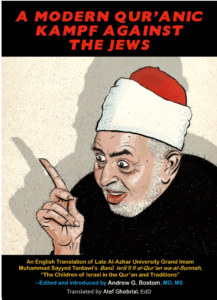
Muhammad Sayyed Tantawi was Grand Imam of Al-Azhar from 1996 until his death in 2010. Before that he was Egypt’s Grand Mufti. He was also a major modern Qur’anic commentator. His al-Tafsir al-Wasit (“The balanced/intermediate interpretation of the Qur’an”) is not an obscure tract dug out by anti-Islam activists. It is a complete modern commentary on the Qur’an by the man who subsequently became Al-Azhar’s highest clerical authority. It is included at Altafsir.com among roughly 100 major Qur’anic commentaries stretching from the earliest centuries of Islam to modern times. Tantawi himself was instrumental in the development of that remarkable scholarly archive.
In other words, if one wants to know how Al-Azhar’s own intellectual tradition has understood these passages in modern times, Tantawi is about as relevant a witness as one could possibly find. And Tantawi does not sound remotely like Sopher’s “master contextualizer”.
On Qur’an 59 he identifies the people concerned explicitly as the Jews of Banu Nadir. He recounts their supposed “treachery and betrayal”, describes their defeat and expulsion as divinely ordained humiliation, and interprets the following verse to mean that even if these Jews escaped killing in this life, they would face everlasting punishment in the next.
One need not accept Tantawi’s interpretation. Many Muslims plainly do not. But Sopher’s argument is not merely that kinder interpretations are possible. He uses his brief encounter at Al-Azhar to imply something much broader about what the institution teaches today. Against that anecdote stands the published Qur’anic commentary of Al-Azhar’s own former Grand Imam.
The problem gets worse with Qur’an 9:29. This is the jihad verse commanding Muslims to fight certain “People of the Book” until they pay the jizya, a poll tax, “in lieu of being slain,” while saghirun — variously translated as subdued, humbled, humiliated or abased.
Sopher presents the resulting dhimma system largely as one of protection: Jews and Christians paid a tax and Islamic law guaranteed their security. This is an oddly bloodless—and bowdlerized—description of a system whose discriminatory character is copiously documented in Islamic jurisprudence itself.
The eleventh-century jurist al-Mawardi explained that conquered non-Muslims could obtain security through tribute, but that if the arrangement ceased, jihad war could resume. Jurists developed restrictions affecting religious buildings, dress, testimony, arms and public status, as well as some explicitly prescribed humiliating procedures for collecting the jizya. Nor is this merely polemical reconstruction by modern critics of Islam. S.D. Goitein, one of the twentieth century’s greatest scholars of Jewish life under Islam, dramatically revised his own assessment after studying the documentary records of the Cairo Geniza. He concluded that the jizya could become a terrifying burden for the poor. He described the tax season as one of “horror, dread, and misery”, with people facing beating, imprisonment and severe deprivation when they could not pay.
And here again we can ask what Al-Azhar’s own major modern commentator thought. Tantawi’s commentary on Qur’an 9:29 states that the alternatives facing the People of the Book are fighting, Islam or jizya. He expressly describes submission to Islamic rule—the Shari’a—and payment of the tax as humiliation.
Sopher is entitled to prefer a more benign interpretation. What he cannot reasonably do is present that interpretation as though the difficult history and mainstream jurisprudential tradition simply evaporate once somebody supplies enough “context”.
Then there is Qur’an 5:60 — the notorious passage describing people whom Allah cursed and transformed into “apes and pigs”. Sopher tries to narrow this to a particular story about Jews violating the Sabbath. But he appears to conflate two different passages. Qur’an 2:65 explicitly connects transformation into apes with Sabbath-breaking. Qur’an 5:60 does not make that same limitation.
Tantawi’s commentary on 5:60 identifies the condemned people as Jews and speaks in sweeping terms of divine curse, anger, corruption and punishment. This language also did not remain buried in medieval libraries.
Tantawi’s own doctoral dissertation, completed at Al-Azhar in 1966 and republished in 1997, while he was Grand Imam, catalogued a long series of negative Qur’anic characteristics attributed to the Children of Israel. Crucially, he argued that these traits were observable not merely among particular ancient Jews but “throughout the ages”. His successor as Grand Imam, Ahmed al-Tayeb, has himself publicly invoked Qur’an 5:82 — “You will surely find the most intense of the people in animosity toward the believers [to be] the Jews” — when discussing Jewish-Muslim relations in the modern world.
And after 7 October 2023, the gulf between Sopher’s reassuring picture of Al-Azhar and Al-Azhar’s actual public discourse became harder still to ignore. Al-Azhar praised Palestinian “resistance” on the day of Hamas’s massacre. Less than two weeks later its fatwa centre issued a ruling rejecting the ordinary civilian classification of Israeli “settlers”. Senior figures associated with the institution subsequently used old Qur’anic language about Jews as “apes and pigs”.
One can debate precisely how representative each statement is. One can distinguish Jews from Israelis, Israelis from Zionists, classical jurisprudence from modern politics, and historical description from contemporary prescription. Serious scholarship should make all of those distinctions. But serious scholarship cannot simply delete inconvenient evidence.
That is what makes Sopher’s project so odd. He is operating in an extremely specialized field while offering conclusions of enormous sweep, yet his treatment of the most difficult evidence is often remarkably shallow. A pleasant conversation with an unidentified imam becomes evidence about Al-Azhar. Part of a verse substitutes for the whole. A highly selective account of dhimma becomes a story about protection. One troublesome Qur’anic passage is apparently explained by importing the context of another.
This is not how one would approach any other religious tradition seriously. While Muslims are not “condemned” to read these verses as Tantawi did, sincere Muslim reformers must engage in something much more intellectually substantial than pretending such authoritative, widely prevalent classical and modern interpretations don’t exist. The question is whether Jewish-Muslim understanding is helped by reassuring Jews that explicitly hostile texts do not really mean anything terribly hostile, even when major Muslim jurists, historians, Qur’anic commentators and Al-Azhar’s own Grand Imams have repeatedly understood them otherwise.
Fruitful interfaith dialogue requires more honesty, not less. If a verse says something disturbing, quote the whole verse. If the corpus of major Qur’anic commentaries, modern and classical, contains competing interpretations, show them, and summarize their consensus, accurately. If the historical record is ugly, acknowledge it. And if you want to demonstrate that a thousand-year-old institution has changed, do not offer up an unnamed cordial imam encountered during a two-day visit. Show us the institution’s authoritative texts and teachings.
In conclusion, Rick Sopher’s aggressively sanitized and deceptive “analysis” of the Qur’an’s characterization of Jews combines chit-chat with treacly dawah (Islamic proselytization), and does not qualify as serious, honest scholarship. This is perhaps best illustrated by Sopher’s hollow and ridiculous claim that the Qur’an somehow, “just wants Jews to be better Jews.” No Mr. Sopher. As Qur’an 3:110 and its authoritative modern gloss by Tantawi make plain, the only Qur’anic path forward to attain Jewish “betterment” is for Jews to convert to Islam!
Andrew Bostom

Andrew G. Bostom is the author of The Legacy of Jihad (Prometheus, 2005) and The Legacy of Islamic Antisemitism " (Prometheus, November, 2008) You can contact Dr. Bostom at @andrewbostom.net