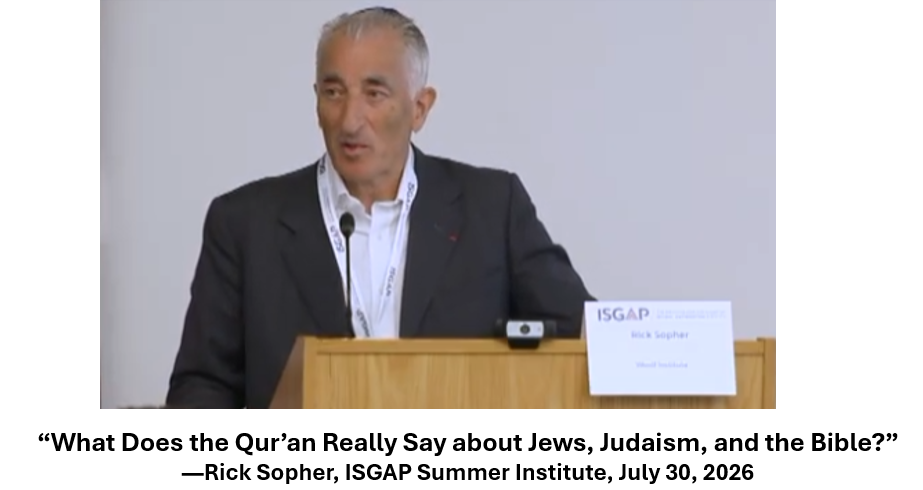
 Rick Sopher, is a banker turned self-described “Interfaith activist.” Sopher has launched a personal jihad of the mouth and pen to combat what he terms “Quranophobia,” culminating in his just released collaborative book entitled, Illuminating Scriptural Connections. A gushing account of Sopher’s mission, with an equally laudatory preview of the book, was published in the Jewish Chronicle (London), 9/6/26. Several days later, Sopher and co-author Abdulla Galadari penned a very brief (~400 word) synopsis of the book that appeared in The Times (London), 9/10/26.
I first learned of Sopher’s quest after observing a lecture Sopher delivered at the ISGAP Summer Institute on July 30, 2026. Extracts from his talk were posted here and subsequently posted in full here, 9/3/26. A complete transcript of his remarks can be read here. The gratuitously apologetic—and counterfactual—gist of Sopher’s thesis can be gleaned from his ludicrous claim near the talk’s conclusion that, “…the Koran (Qur’an) just wants Jews to be better Jews.”
For more than two decades I have undertaken extensive study (here; and especially here) of the authoritative discourse on Jews emanating from the so-called “Vatican” of Sunni Islamic religious education, Al-Azhar University, and particularly, its two most recent Grand Imam near Papal equivalents, Muhammad Sayyed Tantawi (d. 2010) and his successor and still current Grand Imam, Ahmed al-Tayeb. Sopher’s description of his own recent sojourn to Al-Azhar during the 7/30/26 lecture proved to be a fortuitous illumination of his mindset.
In unwitting self-caricature, Sopher’s malevolent naiveté is inadvertently on full display during the Al-Azhar visit. Indeed, his willful blindness to Al-Azhar’s authoritative, monotonously pejorative modern teaching about the Jews is breathtaking, and pathognomonic of his entire misguided approach. Juxtaposing Al-Azhar’s actual contemporary pedagogy about the Qur’an’s depictions of the Jews, including, most importantly, formal tafsir (Qur’anic commentary) by late Al-Azhar Grand Imam and seminal modern Qur’anic commentator Tantawi on specific verses Sopher references and “characterizes,” exposes the crude sophistry Sopher employs.
According to Sopher, earlier this year (2026) he was “very fortunate to be invited to spend a couple of days at Al-Azhar Mosque in Cairo.” Accompanied by a friend, Sopher maintains, they came upon an unidentified imam who was reading and explaining Qur’anic verses, including Q 59:2. That complete verse in context with related verses 59:1 and 59:3-5, are all translated in full just below:
Q 59:1—“Whatever is in the heavens and whatever is on the earth exalts Allah, and He is the Exalted in Might, the Wise.” Q 59:2—“It is He who expelled the ones who disbelieved among the People of the Scripture from their homes at the first gathering/(exile). You did not think they would leave, and they thought that their fortresses would protect them from Allah; but [the decree of] Allah came upon them from where they had not expected, and He cast terror into their hearts [so] they destroyed their houses by their [own] hands and the hands of the believers. So take warning, O people of vision.” Q 59:3—“And if not that Allah had decreed for them evacuation, He would have punished them in [this] world, and for them in the Hereafter is the punishment of the Fire.” Q 59:4—“That is because they opposed Allah and His Messenger. And whoever opposes Allah – then indeed, Allah is severe in penalty.” Q 59:5—“Whatever you have cut down of [their] palm trees or left standing on their trunks – it was by permission of Allah and so He would disgrace the defiantly disobedient.”
Curiously, Sopher only translated for his ISGAP audience the opening (in red, above) of Q 59:2 (and indeed the video presentation confirms he just showed the original Arabic truncated to that same point), not the baleful remainder of the verse, nor the equally threatening context provided by Q 59:3-5. Sopher proceeds to laud the Al-Azhar imam he encountered as a “master contextualizer” for insisting Q 59:2 was merely about anodyne efforts of Islam’s prophet Muhammad “to keep people on [his] side.” Extolling the allegedly ecumenical atmosphere within the Mosque, Sopher notes his “pleasant surprise,” adding a caveat regarding anecdotal experience, immediately melded to a broad, risible claim about Al-Azhar’s relative lack of anti-Jewish teaching at present:
“I know it’s an anecdote and not comprehensive, and that the al-Azhar mosque has been in the past a seat of Muslim Brotherhood teaching, which is much more aggressive, anti-Jewish kind of teaching than it is today. But there we are.”
Late Al-Azhar Grand Imam Tantawi was not a “Muslim Brotherhood ideologue,” but he was one of the most respected modern Sunni Qur’anic exegetes. Tantawi’s own full Qur’anic commentary, “A balanced/intermediate interpretation of the Qur’an,” is among the ~100 major Qur’anic commentaries across space and time, from the 8th through the late 20th centuries, archived at AlTafsir.com, a unique online resource Tantawi was instrumental in creating. What follows are key extracts from Tantawi’s authoritative glosses on Qur’an 59:2, and the intimately related verse 59:3, making plain the treacherous nature of the Jews and their deserving punishment, contra Sopher’s claims of alleged benign “contextualization”:
“Those among the People of the Book (Q 59:2) referred to here are the Jews of Banu Nadir, well-known in the books of Sunnah [hadith] and biography [of Muhammad, or sira]. In summary, these Jews lived on the outskirts of Medina. The Prophet (Muhammad) went to them seeking their help in paying blood money for two men killed by mistake by some Muslims. They received him warmly and expressed their willingness to assist him in whatever he asked. Then, some of them went aside and said, ‘You will never find the man in such a state again. Who among you will climb to the top of this house where Muhammad is sitting and throw a stone at him, thus ridding us of him?’ One of them pledged to do so. Before he could carry it out, Gabriel descended upon the Prophet and informed him of the treachery and betrayal the Jews had plotted. The Prophet returned to Medina and told his companions what the Jews of Banu Nadir had concealed from him…The Prophet ordered his companions to prepare to besiege Banu Nadir and punish them for their treachery. So the believers besieged them for twenty-odd nights, and the matter ended with their expulsion from Medina…He (Allah)- the Exalted – described them as disbelievers and as People of the Book, to denounce them and increase their reproach, since they combined two vices: the vice of disbelief in the truth, and the vice of not knowing their book that commanded them to follow the Messenger (Muhammad) which they find written in their Torah… His (Allah’s) statement (Q 59:2)– ‘So Allah came upon them from where they did not expect and cast terror into their hearts…’ stems from the previous assumption held by the believers (the Muslims) and by their enemies, the Banu Nadir. You thought they would not leave their homes, and they, too, thought their fortresses would prevent them from defeating you. The result was that Allah’s wrath and punishment came upon them from where they least expected it, from where it never crossed their minds. He cast terror and panic into their hearts, so they fled from their fortresses, in which they had sought refuge, and from their homes, which they had inhabited for so long, humbled and humiliated…Then He (Allah) – the Exalted – explained what happened to them during their exile, saying (Q 59:2): ‘They destroy their houses with their own hands and the hands of the believers. So take heed, O you who have eyes!’ Destruction means bringing down a building, demolishing it, or ruining it. That is, these Jews, due to their bad intentions and their disorder, when they decided to leave the city, began to destroy their houses with their own hands, by demolishing their buildings, destroying the sound ones, and removing what they contained of doors and other things, so that the Muslims would not benefit from them after them. They also began to destroy them with the hands of the believers, because the believers were removing every obstacle from their path so that they could storm their homes. As a result, they demolished some of the houses of Banu Nadir from the outside, so that they could gain control over them…if the matter is clear to you, O people, then consider and take heed, O people of sound minds and discerning eyes, from what happened to these Jews, where Allah, the Exalted, orchestrated their expulsion from their homes with a wise plan, and granted victory to the believers over them in the easiest way, and made their homes after them a good lesson and admonition for every discerning person, for they left them behind as a true witness that treachery ends in loss… The phrase (Q 59:3) ‘And for them in the Hereafter is the punishment of the Fire,’ is a new statement. That is, even if these Jews escaped killing and annihilation in this world, they will not escape in the Hereafter the punishment that will humiliate and disgrace them. Rather, they will be afflicted with an eternal torment from which there is no escape.”
Sopher’s attempts to similarly “contextualize” several other Qur’anic verses with hateful implications for Jews merit comparable authoritative exegetic assessment. Two of those verses, 9:29 and 5:60, will be analyzed at length.
Qur’an 9:29 will be discussed first along with its living historical and juridical relevance—past as prologue—to jihadism and the imposition of Sharia, Islamic law on non-Muslim Jews and Christians. Here is Qur’an 9:29 in standard translation (Sahih International, one of 7 widely accepted versions at Qur’anic Arabic Corpus):
“Fight those who do not believe in Allah or in the Last Day and who do not consider unlawful what Allah and His Messenger have made unlawful and who do not adopt the religion of truth from those who were given the Scripture – [fight] until they give the jizya willingly while they are humbled.”
Sopher’s 9:29 “exegesis” insists upon translating the concluding active participle root “ṣāghirūn” as “belittled” whereas as a standard menu of translations suggests “subdued,” “humiliated,” “disgraced,” and “abased,” conveying with historical and doctrinal accuracy the direct nexus to jihad conquest and submission.
In Sopher’s view the consequences of 9:29 were rather trifling. He ignores altogether the essential pattern of jihad war in fulfillment of Qur’an 9:29 as illustrated in the great Muslim historian al-Tabari’s recording of the recommendation given by Umar b. al-Khattab to the commander of the troops he sent to al-Basrah (636 CE), during the conquest of Iraq. Umar reportedly said:
“Summon the people to Allah; those who respond to your call, accept it from them, [This is to say, accept their conversion as genuine and refrain from fighting them] but those who refuse must pay the poll tax out of humiliation and lowliness [Qur’an 9:29]. If they refuse this, it is the sword without leniency. Fear Allah with regard to what you have been entrusted.”
These jihad invasions ravaged, for example, historical Palestine, the rest of the Levant, Iraq, North Africa, further west to the Iberian peninsula, northeast to Dagestan, and further east to India, with their prototypical massacre, pillage, enslavement, and deportation of the indigenous Christians and Jews.
Having negated the sanguinary conquests 9:29 inspired, Sopher proceeds to misrepresent the pact of submission—dhimma—imposed per 9:29 upon the surviving vanquished Jews and Christians. Sopher portrays the dhimma as a noble “protective service” provided by the Muslims:
“…protection of Jews and Christians, as a religious duty for Muslims, as long as they pay the required tax, no one should interfere with their lives or business. Preventing their peaceful living would be a violation of Islamic law.”
In The Laws of Islamic Governance, al-Mawardi (d. 1058), a distinguished jurist of Baghdad, examined the regulations pertaining to the lands and infidel (i.e., non-Muslim) populations subjugated by jihad. This is the origin of the system of dhimmitude. The native infidel population had to recognize Islamic ownership of their land, submit to Islamic law, and accept payment of the poll tax (jizya). He notes that “The enemy makes a payment in return for peace and reconciliation.” Al-Mawardi then distinguishes two cases: (I) Payment is made immediately and is treated like booty, “it does not, however, prevent a jihad being carried out against them in the future” (II). Payment is made yearly and will “constitute an ongoing tribute by which their security is established.” Reconciliation and security last as long as the payment is made. If the payment ceases, then the jihad resumes. A treaty of reconciliation may be renewable, but must not exceed ten years. The nature of such “protection”—from the resumption of murderous jihad—is clarified in this definition of jizya by the renowned Arabic lexicographer E. W. Lane, based on a careful analysis of the etymology of the term:
“The tax that is taken from the free non-Muslim subjects of a Muslim government whereby they ratify the compact that assures them protection, as though it were compensation for not being slain.”
Pace Sopher’s apologetic dilettantism on the jizya, S.D. Goitein, recognized for his meticulous and measured scholarship on Muslim-Jewish relations, in a seminal 1963 essay (which was partly a mea culpa as well), examined the practical impact of the jizya. Goitein’s objective scholarly analysis highlighted the limitation of studying the potential economic and other adverse social consequences of the jizya, some catastrophic, without reference to non-Muslim sources:
“There is no subject of Islamic social history on which the present writer had to modify his views so radically while passing from literary to documentary sources, i.e., from the study of Muslim books to that of the records of the Cairo Geniza as the jizya…or the poll tax to be paid by non-Muslims. It was, of course, evident that the tax represented a discrimination and was intended, according to the Koran’s own words, to emphasize the inferior status of the non-believers. It seemed, however, that from the economic point of view, it did not constitute and heavy imposition, since it was on a sliding scale approximately, one, two, and four dinars, and thus adjusted to the financial capacity of the taxpayer. This impression proved to be entirely fallacious, for it did not take into consideration the immense extent of poverty and privation experienced by the masses, and in particular, their persistent lack of cash, which turned the ‘season of the tax’ into one of horror, dread, and misery. The provisions of ancient Islamic law which exempted the indigent, the invalids, and the old, were no longer observed in the Geniza period [primarily,~ 950-1250 C.E]) and had been discarded by the Shafi’i School of Law, which prevailed in Egypt, also in theory. It is precisely persons of such descriptions about whose plight we read so much in our records. The payment of the poll tax constituted item number one in the budget of families with modest income, such as teachers or laborers. For a man could clothe inexpensively, he could eat at starvation level, as perhaps a very large section of the population did. But he could not escape the tax gatherer—at least not for long. If he was caught, he was beaten and suffered otherwise corporal punishment, ‘nquba,’ and was thrown into prison, where, because of starvation and maltreatment, he faced death…A very considerable section of the non-Muslim population must have been unable to pay it and often suffered humiliation and privation on its account. While, in the higher circles, the prospects of appointment to leading government posts acted as an inducement for embracing Islam, the mass conversions in the lower classes might well have been caused in part by the intolerable burden of the poll tax.”
Another important aspect of the jizya also ignored by Sopher is the widely upheld view of the classical schools of Islamic jurisprudence about the deliberately humiliating imposition and procurement of this tax. Here is a discussion of the ceremonial for collection of the jizya by the thirteenth-century Shafi’ite jurist an-Nawawi:
“The infidel who wishes to pay his poll tax must be treated with disdain by the collector; the collector remains seated and the infidel remains standing in front of him, his head bowed and his back bent. The infidel personally must place the money on the scales, while the collector holds him by the beard, and strikes him on both cheeks.”
Two remarkable accounts demonstrate the humiliating conditions under which the jizya was still being collected within the modern era. An Italian Jew traveling in Morocco in 1894 reported the following:
“The kaid Uwida and the kadi Mawlay Mustafa had mounted their tent today near the Mellah [Jewish ghetto] gate and had summoned the Jews in order to collect from them the poll tax [jizya] which they are obliged to pay the sultan. They had me summoned also. I first inquired whether those who were European-protected subjects had to pay this tax. Having learned that a great many of them had already paid it, I wished to do likewise. After having remitted the amount of the tax to the two officials, I received from the kadi’s guard two blows in the back of the neck. Addressing the kadi and the kaid, I said ‘Know that I am an Italian protected subject.’ Whereupon the kadi said to his guard: ‘Remove the kerchief covering his head and strike him strongly; he can then go and complain wherever he wants.’ The guards hastily obeyed and struck me once again more violently. This public mistreatment of a European-protected subject demonstrates to all the Arabs that they can, with impunity, mistreat the Jews.”
Avram Elmaleh, head of the Fez, Morocco boys’ school, in a letter from January 30, 1911, to the president of the Alliance Israelite Universelle in Paris, portrayed the degradations inflicted upon the rabbinical leaders of the Moroccan Jewish community in connection with “community business” (i.e., such as payment of the jizya), even into the second decade of the twentieth century:
“I have the honor to acknowledge receipt of your letter No. 1283 of 30 January, enclosing a letter from Rabbi Vidal Sarfaty. The rabbi asks you to intervene with Si Mohamed el Mokri, the Moroccan Minister of Foreign Affairs, at present in Paris, for the abolition of the degrading custom imposed on Jews, not to enter Dar el Maghzen except barefoot. Unfortunately, the facts given in Rabbi Vidal’s letter are correct. Jews must take off their shoes at the gate of Dar-Maghzen. Quite apart from the humiliation involved in this measure, it is an intolerable suffering for our co-religionists to be obliged to stand many hours barefoot on the earth of the Palace courtyard, which is either cold and damp or white-hot from the summer sun. Rabbi Vidal, a regular visitor to the Dar-Maghzen in connection with community business or on behalf of individuals, has often returned ill from a rather too long sojourn in front of the offices. It is my opinion that it would be impossible to obtain an order from the Sultan to allow Jews to enter the Palace with their shoes on. It is a concession which his pride would not permit, and one quite contrary to the Muslim conception of the relative positions of the Jews and themselves.”
Moreover, the contract of the jizya or dhimma, derived from Qur’an 9:29, encompassed other obligatory and recommended obligations for the conquered non-Muslim dhimmi peoples. Collectively, these “obligations” formed the discriminatory system of dhimmitude imposed upon Jews and other non-Muslims, subjugated by jihad. Some of the more salient features of dhimmitude include: the prohibition of arms for the vanquished non-Muslims (dhimmis) and of church bells; restrictions concerning the building and restoration of churches, synagogues, and temples; inequality between Muslims and non-Muslims with regard to taxes and penal law; the refusal of dhimmi testimony by Muslim courts; a requirement that Jews, Christians, and other non-Muslims wear special clothes; and the overall humiliation and abasement of non-Muslims. It is important to note that these regulations and attitudes were institutionalized as permanent features of the sacred Islamic law, or Sharia. The writings of the much-lionized Sufi theologian and jurist al-Ghazali (d.1111)—the famous theologian, philosopher, and paragon of mystical Sufism, who, as noted by the renowned scholar W. M. Watt, has been “acclaimed in both the East and West as the greatest Muslim after Muhammad”—highlight how the institution of dhimmitude was simply a normative and prominent feature of the Sharia:
“[T]he dhimmi is obliged not to mention Allah or His Apostle…Jews, Christians, and Majians [Zoroastrians] must pay the jizya [poll tax on non-Muslims]…on offering up the jizya, the dhimmi must hang his head while the official takes hold of his beard and hits [the dhimmi] on the protruberant bone beneath his ear [i.e., the mandible]…They are not permitted to ostentatiously display their wine or church bells…their houses may not be higher than the Muslim’s, no matter how low that is. The dhimmi may not ride an elegant horse or mule; he may ride a donkey only if the saddle[-work] is of wood. He may not walk on the good part of the road. They [the dhimmis] have to wear [an identifying] patch [on their clothing], even women, and even in the [public] baths…[dhimmis] must hold their tongue.”
Sopher extols the theoretical Ottoman dhimma for Jews based entirely upon a firman issued by the Ottoman despot, Sultan Mehmet III, in 1602. Notwithstanding Sopher’s hagiography, the Polish Jew, Gedaliah of Siemiatyce (d. 1716), who, braving numerous perils, came to Ottoman-controlled Jerusalem in 1700, produced an eyewitness account of the actual plight of both Palestinian Jews and Christians subjected to the jizya, and other attendant forms of social, economic, and religious discrimination, often brutally imposed. These appalling conditions, recorded in his book, Pray for the Peace of Jerusalem compelled him to return to Europe to raise funds for the Jews of Jerusalem.
“In addition to the expenses in bribes destined to win the favor of the Muslims, each male was obliged to pay an annual poll tax of two pieces of gold to the sultan. The rich man was not obliged to give more, but the poor man could not give less. Every year, generally during the festival of Passover, an official from Constantinople would arrive in Jerusalem. He who did not have the means to pay the tax was thrown into prison and the Jewish community was obliged to redeem him. The official remained in Jerusalem for about two months and consequently, during that period, the poor people would hide wherever they could, but if they were ever caught, they would be redeemed by community funds. The official sent his soldiers throughout the streets to control the papers of the passersby, for a certificate was provided to those who had already paid the tax. If anyone was found without his certificate, he had to present himself before the official with the required sum, otherwise he was imprisoned until such time as he could be redeemed…The Christians are also obliged to pay the poll tax…No Jew or Christian is allowed to ride a horse, but a donkey is permitted, for [in the eyes of Muslims] Christians and Jews are inferior beings… The Muslims do not allow any member of another faith—unless he converts to their religion—entry to the Temple [Mount] area, for they claim that no other religion is sufficiently pure to enter this holy spot. In the Land of Israel, no member of any other religion besides Islam may wear the color green, even if it is a thread [of cotton] like that with which we decorate our prayer shawls. If a Muslim perceives it, that could bring trouble. Moreover, the Muslim law requires that each religious denomination wear its specific garment so that each people may be distinguished from another. This distinction also applies to footwear. Indeed, the Jews wear shoes of a dark blue color, whereas Christians wear red shoes. No one can use green, for this color is worn solely by Muslims. The latter are very hostile toward Jews and inflict upon them vexations in the streets of the city… the common folk persecute the Jews, for we are forbidden to defend ourselves against the Turks or the Arabs. If an Arab strikes a Jew, he [the Jew] must appease him but dare not rebuke him, for fear that he may be struck even harder, which they [the Arabs] do without the slightest scruple. This is the way the Oriental Jews react, for they are accustomed to this treatment, whereas the European Jews, who are not yet accustomed to suffer being assaulted by the Arabs, insult them in return. Even the Christians are subjected to these vexations. If a Jew offends a Muslim, the latter strikes him a brutal blow with his shoe in order to demean him, without anyone’s being able to prevent him from doing it. The Christians fall victim to the same treatment and they suffer as much as the Jews, except that the former are very rich by reason of the subsidies that they receive from abroad, and they use this money to bribe the Arabs. As for the Jews, they do not possess much money with which to oil the palms of the Muslims, and consequently they are subject to much greater suffering.”
Key extracts of former Al-Azhar Grand Imam Tantawi’s contemporary gloss on Qur’an 9:29, which derives from and validates the classical exegetic and juristic consensus on waging jihad, collecting the jizya as a form of humiliation, being subjected to the Sharia (and therefore, its broad, debasing inequalities for non-Muslims), and suffering eternal damnation in the Hereafter, are presented below:
“The intended meaning of His statement, ‘of those who were given the Scripture,’ is to distinguish them from the polytheists who worship idols in terms of ruling, because the ruling for the latter is to fight them until they submit to Islam, while the ruling for the People of the Scripture is fighting, or Islam, or the jizya. His statement, ‘until they pay the jizya willingly while they are subdued,’ is an end to fighting. That is, fight those of the People of the Book (Jews, Christians, Zoroastrians)…those who do not believe in Allah or the Last Day, and do not forbid what Allah and His Messenger have forbidden…until they pay the jizya willingly and obediently… the humiliation is their commitment to the implementation of Allah’s rulings [the Sharia] upon them, and paying the jizya, because that is humiliation…they do not take the true religion [Islam] as their religion. They deserve this humiliation in this world, but in the Hereafter, their punishment will be more severe and lasting…”
Al-Azhar’s near 80-year continuum of fatwas and other religious discourse sanctioning a global Muslim jihad against the Jews of Israel confirm the living agency of Qur’an 9:29 in the eyes of this authoritative Islamic institution’s clerical leaders.
Al-Azhar clerics issued three fatwas calling for the global Muslim umma to wage jihad to destroy the creation of a nascent, autonomous Israel, liberated from the Sharia: just after the announcement of the 1947 partition plan, upon Israel’s 1948 declaration of independence, and following the defeat of the Arab Muslim jihad war, at the close of 1948. These Al-Azhar edicts, unsurprisingly, were redolent with classical Islamic jihadism, and conspiratorial Islamic Jew-hatred.
Seven years after the 1949 armistice agreements, two complementary fatwas, one by then grand mufti of Egypt, Sheikh Hasan Ma’moun, written January 5, 1956, and another January 9, 1956, signed by the leading members of the Fatwa Committee of Al Azhar, and Al Azhar’s major representatives of all four Sunni Islamic schools of jurisprudence, re-stated and elaborated the rationale for the jihad against the Jews of Israel. Bearing in mind that Egypt then occupied Gaza, and Jordan occupied Judea-Samaria (the West Bank), nonetheless, these religious rulings maintained that all of historical Palestine—modern Jordan, Israel, and the disputed territories of Judea and Samaria, as well as Gaza—having been conquered by jihad, was a permanent possession of the global Muslim umma (community), “fay territory”—booty or spoils—to be governed eternally by Islamic law.
“Muslims cannot conclude peace with those Jews who have usurped the territory of Palestine and attacked its people and their property in any manner which allows the Jews to continue as a state in that sacred Muslim territory. [As] Jews have taken a part of Palestine and there established their non-Islamic government and have also evacuated from that part most of its Muslim inhabitants. . . . Jihad . . . to restore the country to its people . . . is the duty of all Muslims, not just those who can undertake it. And since all Islamic countries constitute the abode of every Muslim, the Jihad is imperative for both the Muslims inhabiting the territory attacked, and Muslims everywhere else because even though some sections have not been attacked directly, the attack nevertheless took place on a part of the Muslim territory which is a legitimate residence for any Muslim… Everyone knows that from the early days of Islam to the present day the Jews have been plotting against Islam and Muslims and the Islamic homeland. They do not propose to be content with the attack they made on Palestine and Al Aqsa Mosque, but they plan for the possession of all Islamic territories from the Nile to the Euphrates.”
A year after Israel’s decisive victory during the 1967 war, Al-Azhar convened the 4th Conference of the Academy of Islamic Research in Cairo, which assembled prominent Muslim theologians not only from the Middle East, but Asia, Africa, and Europe. This seminal, if ugly Conference, marked the formal abandonment of pseudo-secular “Arab Nationalism” as a guiding ideological rationale for the simmering conflict with Israel. Published in English as a 935pp. tome in 1970, the Conference Proceedings were the subject of late historian David Littman’s pioneering analysis, in 1971. Littman summarized the Conference’s six key “recurring themes,” as follows:
1) “Jews are frequently denoted as the ‘Enemies of Allah’”
2) “Jews manifest in themselves an historical continuity of evil qualities…as described in the Qur’an”
3) “The Jews do not constitute a true people or nation”
4) “The State of Israel is the culmination of the historical and cultural depravity of the Jews…It has to be destroyed by a Jihad”
5) “The superiority of Islam over all other religions is brandished as a guarantee that the Arabs will ultimately triumph”
6) “It is outrageous for the Jews, traditionally kept by Arab Islam in a humiliated, inferior status, and characterized as cowardly, to defeat the Arabs, have their own State, and cause the contraction of the ‘abode of Islam’”
During the so-called “Second Palestinian Muslim Intifada”—punctuated by several dozen mass casualty homicide bombings against Israeli non-combatants—then Al-Azhar Grand Imam Tantawi fomented these depredations with a general call for jihad on October 10, 2000, and further sanctioned homicide bombings of civilians, specifically, even after the gruesome Netanya Passover massacre in March 27, 2002:
[October 10, 2000] “Jihad in the path of Allah is a virtue that binds Muslims at all times, and it is an obligation on everyone who is able to carry it out, and tens of Qur’anic verses narrate the virtue of Jihad in the path of Allah, as well as tens of prophetic Hadiths [traditions]…It is obligatory for the entire [Islamic] nation [umma]… to support them [Palestinian Muslims] in their Jihad.”
[April 4, 2002] “The great Imam of Al-Azhar, Sheikh Muhammad Sayyed Tantawi, demanded that the Palestinian people, of all factions, intensify the martyrdom operations against the Zionist enemy, and described their martyrdom as the highest form of jihad. He says that the young people executing them have granted Allah the most precious thing. He emphasized that every martyrdom operation against any Israeli, including women, children and teenagers, is a legitimate act according to religious law, and an Islamic commandment…”
Then Mufti of Egypt, and current Grand Imam of Al-Azhar Ahmed al-Tayeb added on 4/4/2002,
“…the solution to the Israeli terror lies in a proliferation of Fidai [martyrdom] attacks that strike horror into the hearts of the enemies of Allah (Qur’an 3:151; 8:12). The Islamic countries, peoples and rulers alike, must support these martyrdom attacks… the martyrdom operations carried out by the sons of Palestine are the highest form of martyrdom and the pinnacle of jihad in the path of Allah.”
Al-Azhar’s present learned Muslim theologians issued a fatwa October 19, 2023, pertaining to the simmering conflict sparked by Hamas’ October 7, 2023 invasion of southern Israel. Absent any mention of Hamas’ jihad carnage—murdering, dismembering, torturing, raping, and burning some 1400 largely non-combatant Israelis, including infants, children, women, and the elderly—the fatwa ruled that all Israel’s citizens remained legitimate targets for such heinous jihad depredations. This Al-Azhar ruling was celebrated by Al-Qaeda, and came on the heels of an earlier official Al-Azhar statement celebrating the jihad massacres of Hamas 10/7/23 while they were ongoing, as “the resistance efforts of the proud Palestinian people.”
Without identifying the verse—it is Qur’an 5:60—Rick Sopher argues that the “nastiest verse in the Qur’an about Jews,” is “the one where it calls them apes and pigs.” Once again, since Sopher misrepresents this specific verse, verbatim translation is provided below (which includes a link to 6 other standard translations), debunking his claim that Q 5:60 was “revealed” because of “Jewish sabbath breaking.” For clarification, Qur’an 2:65, which refers to apes, exclusively, does invoke sabbath breaking (“those who transgressed among you concerning the sabbath, …and We said to them, ‘Be apes, despised.’”)
Here in contrast, is the entirety of Q 5:60:
“Say, ‘Shall I inform you of [what is] worse than that as penalty from Allah? [It is that of] those whom Allah has cursed and with whom He became angry and made of them apes and pigs and slaves of Taghut. Those are worse in position and further astray from the sound way.’”
Taghut, according to great classical Qur’anic exegetes such as Tabari and Ibn Kathir, refers to everything worshipped beside Allah, including, prominently Satan (see Tabari’s Qur’anic commentary on Q 2:256 mentioning Taghut as Satan here and here). Idols, sorcerers, fortune tellers, and “misguiding” authorities are also associated with Taghut.
Defining Taghut to include Satan, like Tabari, in his own commentary on Q 2:256, late Al-Azhar Grand Imam Tantawi maintained,
“The word ‘false deities’ (Taghut) refers to everything that leads a person astray, such as idols, false gods, Satan, every leader of misguidance, and everything worshipped besides Allah.”
Tantawi’s modern gloss (here; here) on Q 5:60 is generally consistent with its classical exegesis re-affirming the Jews’ punishment (i.e., transmogrification into apes and pigs) was due to worshipping “every false deity besides Allah.” His 5:60 commentary condemns Jewish “evil,” and “the ugliness of their position,” as the justification for their consignment to Hell in the Hereafter. Key extracts from Tantawi’s commentary are presented below:
“Then He [Allah]—exalted is He—continued to mock them, and the people were astonished at the absurdity of their opinion, while reminding them of their evil fate, saying, “Say, ‘Shall I inform you of something worse than that as a reward with Allah?’” The reference in His saying “that” is to what the Jews resented in the believers for their faith in Allah and the heavenly books…And His saying ‘whom Allah has cursed’…meaning: He is the one whom Allah has cursed, and what is meant is the Jews, because the attributes mentioned in the verse apply only to them. The meaning is: Say, O Muhammad, to these Jews who criticized the believers for their faith in Allah and in what He revealed of heavenly books, and who said to you: We do not know of any religion less fortunate in this world and the Hereafter than yours, nor any religion worse than yours, say to them, by way of rebuke and warning of their error: Has anyone from the people of that religion informed you of a punishment from Allah on the Day of Resurrection? He is the one whom Allah has cursed, meaning He has distanced him from His mercy, ‘and with whom He has become angry’ by withholding His pleasure from him, ‘and made some of them into apes and pigs,’ that He transformed some of them into apes and some into pigs, and made some of them worship the false deity, that is, those who worshipped every false deity besides Allah, such as idols, statues, and other false deities that they followed because of their tyranny and the corruption of their souls. If it is said that His statement, “Say, ‘Shall I inform you of something worse than that as a reward?’” implies that what the Jews criticized the believers for regarding their faith in Allah contained evil, then how can it be that what the Jews were upon was even more evil, while the believers’ faith contained no evil whatsoever, but was in fact the very essence of goodness? The answer is that the statement is presented in a manner of parallelism, echoing the corrupt thinking and false claims of the Jews. It is as if Allah—exalted is He—is saying to His Prophet, ‘These Jews, O Muhammad, deny your belief in Allah and the heavenly books, considering it evil—even though it is the very essence of good. Tell them, by way of rebuke and compelling them with proof, ‘If you criticize our faith and consider it evil with no good in it—in your view—then what you yourselves are upon, being cursed and expelled from Allah’s mercy, and what befell your forefathers, some of whom were transformed into apes and others into pigs, and what is known of your worship of other than Allah…’ …‘Those are worse in position.’ And they are more astray from the right path. This is an explanation of their evil end and the ugliness of their position. That is, those who are characterized by the aforementioned wickedness, curse, and expulsion from Allah’s mercy are more astray from the straight path than others. In this world, they associate partners with Allah and violate His prohibitions, and in the Hereafter, their abode will be Hell, a wretched destination.”
Predictably, there is also no honest discussion in Sopher’s bowdlerized presentation of how the Qur’anic epithets “apes/monkeys,” and/or “pigs” (per Q 5:60, 2:65, and 7:166) have been employed to incite murderous violence against Jews, starting with Islam’s prophet Muhammad himself. The sira accounts (i.e., the earliest sacralized, pious Muslim biographies of Muhammad) record that the Muslim prophet used these Qur’anic epithets to characterize the Qurayza tribe, Jewish victims of his jihadist campaign, whose surrendered males Muhammad subsequently beheaded. Just prior to orchestrating the en masse execution of the adult males from the besieged Medinan Jewish tribe the Banu Qurayza (and distributing their women, children, and possessions as slave “booty” for the Muslims), Muhammad, according to his earliest Muslim biographer, Ibn Ishaq (d. 767/770) addressed these Jews with menacing, hateful derision: “You brothers of monkeys, has Allah disgraced you and brought His vengeance upon you?” Another early Muslim biographer of Muhammad, Ibn Sa‘d [d. 845], reports that Muhammad stated, “brothers of monkeys and pigs, fear me, fear me!”, while Ibn Kathir’s [d. 1373] biography, states,
“When the Messenger of Allah alighted at the fortresses, they being high above him, he addressed a group of their nobles at the top of his voice so that they could hear him saying, ‘Respond, you tribe of Jews, you brothers of apes, for disgrace from Allah, Almighty and Glorious is He, has come down upon you.”
Here is Ibn Ishaq’s description of Muhammad’s mass beheading of the vanquished Banu Qurayza males:
“When they [the men, including post-pubescent boys, of the Jewish tribe] surrendered, and the apostle [i.e., Muhammad] confined them in Medina in the quarter of d. al-Harith, a woman of B. Al-Najjar. Then the apostle went out to the market of Medina (which is still its market today) and dug trenches in it. Then he sent for them and struck off their heads in those trenches as they were brought out to him in batches. Among them was the enemy of Allah Huyayy b. Akhtab and Ka’b b. Asad their chief. There were 600 or 700 in all, though some put the figure as high as 800 or 900. As they were being taken out in batches to the apostle they asked Ka’b what he thought would be done with them. He replied, ‘Will you never understand? Don’t you see that the summoner never stops and those who are taken away do not return? By Allah it is death!’ This went on until the apostle made an end of them.”
Consistent with the Qur’an’s idealization of Muhammad’s behavior (Q 33:21) as the “example” for all Muslims, these dehumanizing Qur’anic references to Jews as apes (or apes and pigs) were used explicitly for polemical incitement to large scale, murderous pogroms against dhimmi Jewish communities in Granada (within mythically “tolerant” Muslim Spain) during 1066, Baghdad and its environs, proliferating into Iran, at the end of the 13thcentury, and southern Morocco at the close of the 15th century.
Continuing this ignoble practice, during April, 2002, Grand Imam Tantawi in the teeth of the 2nd Palestinian Muslim “Intifada,” publicly denounced the Jews, broadly, as “the enemies of Allah, descendants of apes and pigs.”
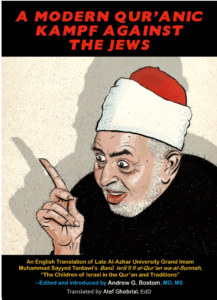
Tantawi’s Al-Azhar University Ph.D. thesis magnum opus on the Jews, “The Children of Israel in the Qur’an & Traditions,” (successfully defended in 1966, and published in1968) included this summary litany of their timeless negative traits as elucidated in the Qur’an:
“The reader of the Noble Qur’an will clearly see that it has depicted many of the inappropriate conducts, despicable manners and cunning and crooked behaviors that the Children of Israel indulged in. It has branded them with disbelief (Q4:46), ingratitude (Q 45:16-17), egotism (Q 2:87, 2:41), cowardice (Q 2:96, 59:13), deceit (Q 2:74), rebellion (Q 5:24, 5:64), transgression (Q 5:62), cruelty (Q 2:74), deviance (2:135), hastening to transgression and aggression (Q 5:70-71), unjustly consuming people’s wealth (4:161), and many more of the vices that are recorded in the Noble Qur’an. They therefore earned Allah’s displeasure, were stripped of Allah’s mercy and compassion, and they were stricken with disgrace and misery (Q 2:61, 3:112). These vices that the Noble Qur’an recorded can be clearly seen anywhere and throughout the ages. The passage of time has only made these vices more ingrained and rooted in them.”
Three decades later, just over 14 months after becoming Al Azhar Grand Imam, Tantawi’s May 29, 1997, brief introduction to the re-publication of his Ph.D. thesis included these words, reiterating its underlying pejorative purpose:
“My main goal for choosing the topic of my dissertation ‘The Children of Israel in the Qur’an and the Sunna [Traditions]’ is to reveal—to Muslim youth in particular and to the rational, reasonable and fair-minded people in general—the state of the Children of Israel (i.e., Jews), their history, ethics, lies, depravity and immorality, relying on what has been mentioned about them in the Holy Qur’an, the Sunna and the correct and unequivocal historical facts.”
Tantawi colleague, former head of Al-Azhar’s religious fatwa (edict) committee, and “top Azhari” cleric Sheikh Attiya Saqr, in March 2004, enumerated twenty groups of indelible, pejorative (and somewhat redundant) Qur’anic characteristics of Jews, replete with verse citations: [1] being liars, even concerning Allah, let alone non-Jews (3:75), sowers of war and corruption (5:64), and slayers of prophets (3:181), therefore consigned to hellfire (3:181); enraptured listeners to lies, and distorters of the meaning of words, so they are disgraced in the corporeal world, and tormented in the afterworld (5:41); [3] disobeying Allah, breaking their covenant, and being hard-hearted and cursed (again; 5:13); [4] being disputatious and quarrelsome (2:247); [5] hiding the truth and supporting deception by “altering” the Qur’an (3:78); [6] rebelling against and rejecting prophetic guidance (2:55); [7] Satanic hypocrisy, directed at Muslims (2:14; 2:44); [8] denying prophethood and even killing other prophets (2:87); [9] misleading and wishing evil upon others (2:109); [10] despairing at others success, and rejoicing in their failure (3:120); [11] arrogantly proclaiming they are held in special favor by Allah (5:18); [12] being usurious and consuming others wealth (4:161); [13] being rude, vulgar, and disobedient in mocking Islam (4:46); [14] killing the innocent prophets unmercifully (and therefore having humiliation and poverty pitched upon them; 2:61); [15] hard-hearted, mercilessness (2:74); [16] never keeping oaths and being disbelievers (2:100); [17] rushing to commit sin and evil (5:79); [18] cowardice and obsessive love for the worldly (2:96; 59:13–14); [19] extreme miserliness (4:53); and [20] distorting the divine Qur’anic revelation (2:79).
Another glaring omission from Sopher’s selectively and subjectively “Jew-friendly” rendering of the Qur’an’s depiction of Jews is the central Jew-hating verse Q 5:82, which declares, “You will surely find the most intense of the people in animosity toward the believers (the Muslims) [to be] the Jews…”. Tantawi’s gloss on Qur’an 5:82 from his authoritative modern Qur’anic commentary, states:
“The Almighty’s (Allah’s) words, ‘You will surely find the most intense of the people in animosity toward the believers to be the Jews’…is a statement that serves to reinforce verses that documented the many despicable characteristics, and crooked and cunning ways of the Jews. Their enmity is rooted in envy, spite, stubbornness, and pride…the Apostle (Muhammad) said, ‘Whenever a Jew is alone with a Muslim, he (the Jew) will strive to kill him (the Muslim).’”
Tantawi’s successor as Al-Azhar Grand Imam, who still serves in that role, Ahmed al-Tayeb twice (here; here) on national Egyptian television condemned Jews, eternally, while invoking Qur’an 5:82, for causing “Muslim distress…since the inception of Islam 1400 years ago.” Making no distinction between Jews and Zionists, or Judaism and Zionism, during an interview with Al-Tayeb, which aired on Channel 1, Egyptian TV, October 25, 2013, the current Grand Imam gave a brief explanation of the ongoing relevance of Q 5:82 which has been invoked, “successfully,” to inspire violent Muslim hatred of Jews since the advent of Islam:
“A verse in the Qur’an explains the Muslims’ relations with the Jews…This is an historical perspective, which has not changed to this day. See how we suffer today from global Zionism and Judaism…Since the inception of Islam 1,400 years ago, we have been suffering from Jewish and Zionist interference in Muslim affairs. This is a cause of great distress for the Muslims. The Qur’an said it and history has proven it: ‘You shall find the strongest among men in enmity to the believers to be the Jews (Q 5:82)…’ ”
Finally, I discussed earlier an official pronouncement from Al-Azhar on 10/7/23 lauding Hamas’ jihad carnage in southern Israel as “resistance” of the “proud Palestinian people,” followed less than 2-weeks later by a formal fatwa admonishing the entire global Muslim “umma” to join in a jihad targeting all Israeli Jews, indiscriminately. Within a week of 10/7/23, additional Al-Azhar luminaries expressed their support of Hamas’ actions and their condemnation of the Jews, invoking readily identifiable Qur’anic motifs of Jew-hatred. Muhammad Omar Al-Qady, dean of the Faculty for Islamic and Arabic Studies at Al-Azhar, addressed Hamas’ October 7th attacks in posts on his personal Facebook account October 17 and 18, 2023. He praised the Hamas attackers and longed for the liquidation of the Jews, whom he called “the descendants of apes and pigs (Qur’an 5:60).” Al-Qady’s October 17, 2023 post intoned:
“[When I say] resistance I mean the jihad fighters in Palestine, who defend their honor and land, those who fight against their enemy and ours, namely the Jews… I ask Allah to strengthen His soldiers and His camp and grant our brothers in Gaza, in Palestine and in the rest of the Muslim countries victory over their enemy and ours, the enemy of Allah and humanity, the cursed descendants of apes and pigs [i.e., the Jews, per Q 5:60].”
Referencing additional Qur’anic condemnations of Jews, Al-Qady wrote on October 18, 2023: “Allah, bring perdition upon the cursed (Qur’an 5:78) and treacherous (Jews), the murderers of prophets (Qur’an 2:61, 3:112)…” And Abbas Shuman, current inspector general of Al-Azhar’s Fatwa committees, at his Facebook account, October 7, 2023, expressed support for Hamas’ terror attack earlier that day, and on October 18, 2023 “rejoiced” over “the demise of the descendants of apes and pigs.”
In conclusion, Rick Sopher’s aggressively sanitized and deceptive “analysis” of the Qur’an’s characterization of Jews combines bavardage with treacly dawah, and does not qualify as serious, honest scholarship. This is perhaps best illustrated by Sopher’s hollow and ridiculous claim that the Qur’an somehow, “just wants Jews to be better Jews.” No Mr. Sopher. As Qur’an 3:110 and its authoritative modern gloss by Tantawi make plain, the only Qur’anic path forward to attain Jewish “betterment” is for Jews to convert to Islam!
Res ipsa loquitur:
Q 3:110—“You [Muslims] are the best nation produced [as an example] for mankind. You enjoin what is right and forbid what is wrong and believe in Allah. If only the People of the Scripture had believed, it would have been better for them. Among them are believers [Muslims], but most of them are defiantly disobedient.”
Key extracts from Tantawi’s gloss on Q 3:110—“ Muslims, knowledgeable in the teachings, etiquette, Sunnah, and Shari’ah of Islam, you have been found to be the best nation brought forth and made manifest to mankind, for the purpose of upholding the word of truth and refuting falsehood…[E]njoining good and forbidding evil…are the safeguards of the religion [Islam]. A nation cannot be built upon goodness and virtue except by upholding them. These are among the reasons why the Children of Israel (Jews) were cursed for abandoning them… ‘Among them are believers, but most of them are transgressors’. Which of the People of the Book believed in Allah and accepted His Messenger Muhammad and followed the truth he brought?… This noble statement is a just assessment of the small group of believers among the People of the Book, such as Abdullah ibn Salam [a Jew who converted to Islam] and others who embraced Islam. It also condemns the majority of the People of the Book who rejected the truth and strayed from the straight path.”
Andrew Bostom

Andrew G. Bostom is the author of The Legacy of Jihad (Prometheus, 2005) and The Legacy of Islamic Antisemitism " (Prometheus, November, 2008) You can contact Dr. Bostom at @andrewbostom.net