Here is the verbatim text of the article:
https://www.thetimes.com/comment/columnists/article/links-quran-torah-build-bridges-ndhnjfxc2
“Links between Quran and Torah can help build interfaith bridges”
Instead of being a source of tension between faiths, a recognition of the connections between the scriptures has the potential to foster mutual respect
Rick Sopher and Abdulla Galadari, Thursday September 10 2026, 8.19pm BST, The Times
At a time when Muslim-Jewish relations have reached new lows amid wars in the Middle East and imported tensions, readers may be surprised that a ray of light can be found in unexpected sources. Contrary to some popular belief, the holy scriptures of Judaism and Islam offer a route to better understanding between followers of those faiths.
The Quran provides surprising connections to Jewish and Christian scripture. By some measures, at least one third of its verses address material found in the Hebrew Bible. Western scholarship tended to view the Quran’s many differences from the Bible as “mistakes”, an approach that set Judaism and Christianity on a theological collision course with Islam.
Yet recent academic scholarship has tended to regard these discrepancies not as errors but the result of scriptures conveying different messages to different peoples at different times. Differences need not be regarded as contradiction. Instead of being a source of tension between faiths, a recognition of the connections between the scriptures has the potential to foster mutual respect.
This is why we, a British Jew and a Muslim scholar, have written a book that explains similarities as well as differences between the Quran and the Torah. Despite the outbreak of wars during our five-year collaboration, we found comfort in recognising that the similarities in the texts are greater than the differences.
We did not avoid the Quran’s critical comments on some Jews but found that, read in their historical context or measured against the criticisms of Jews contained in the Bible, even the harshest sounding verses of the Quran need not be seen as problematic or requiring perpetual enmity with Jews or Christians.
Most Jews and Christians have never read the Quran, and most Muslims have never read the Bible. Yet the result of shunning the scripture of the “other” is suspicion and it is likely that a part of Islamophobia includes what we have termed “Quranophobia”, the erroneous fear or contempt of the Quran as the engine driving global terrorism.
In an era when popular tropes and slogans easily take hold, a clearer understanding of the other’s scripture may help to dispel mutual suspicion, provide an anchor from which popular sentiment should not be able to drift too far, and foster improved dialogue and relations between the Abrahamic faiths.
Rick Sopher is an interfaith activist; Abdulla Galadari is assistant professor at Khalifa University, Abu Dhabi. Their book, Illuminating Scriptural Connections, is published this month
Andrew Bostom

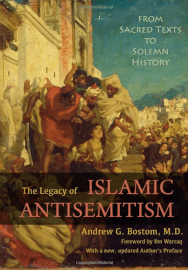
Andrew G. Bostom is the author of The Legacy of Jihad (Prometheus, 2005) and The Legacy of Islamic Antisemitism " (Prometheus, November, 2008) You can contact Dr. Bostom at @andrewbostom.net