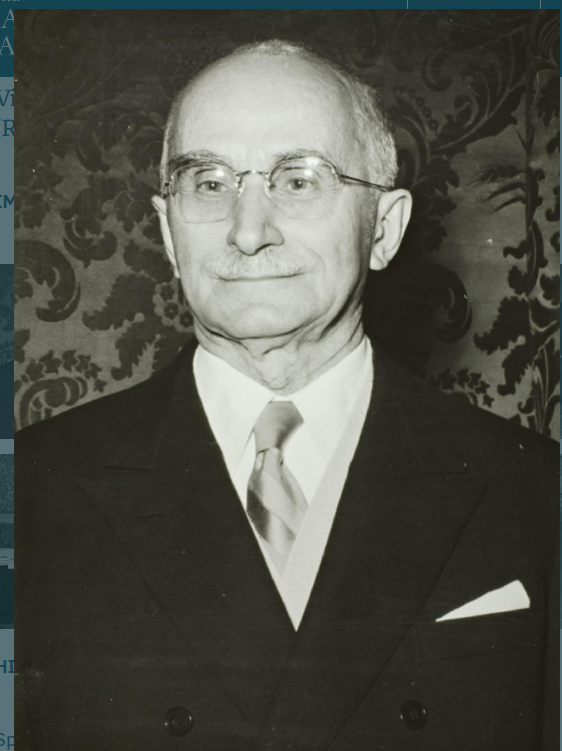
Sixty years ago, G.-H. Bousquet elucidated the quintessential nature of the Sharia, and why Muslims seek, endlessly, to impose this system upon all of humanity. Georges Henri (G.-H.) Bousquet (1900-1978), was one of the greatest and most widely published 20th century specialists on Islamic Law. From 1932 to 1956 Bousquet taught North African sociology at the Faculty of Law in Algeria. His major legal writings include Precis elemantaire de droit muslmane (1936-1940), Du droit musulman et de son application effective dans le monde (1949), Justice francais et coutumes kabiles (1950), and L’Ethique sexuelle de l’Islam (1966).
Bousquet, in his seminal L’Ethique sexuelle de l’Islam (“The Sexual Ethics of Islam”), extracted below, highlights the “doubly totalitarian” nature of Islam—its eternal quest to impose a universal ruling order by jihad warfare—and the permanently stunted “evolution” of that “order”, i.e., Islamic Law, the Sharia. Analogous to the undifferentiated cloaca*, which accounts for it being a “casuistic hodegepodge,” Islam’s Sharia is a retrogressive development compared to the evolution of clear distinctions between “ritual, the law, moral doctrine, good customs in society, etc” within Western European Christendom, and utterly incompatible with modern Western conceptions of universal human rights. [*The cloaca, in zoological anatomy is the posterior orifice that serves as the joint opening for both the intestinal and urinary tracts of certain animal species. Also known as the anal beak, the word cloaca derives from Latin, meaning “sewer.” All birds, reptiles, and amphibians possess this combined excretory opening, from which they eliminate both urine and feces, unlike placental mammals, who possess two separate orifices for evacuation.]
Islam’s doubly totalitarian nature: Jihad and Sharia
“By force of arms at first, the Muslims had acquired a good part of the civilized world and had created quite strong states, yet without realizing their ideal—the first totalitarian aspect of this religion: to conquer the entire world in order to subject it to a single authority (i.e., via jihad). Moreover—and this gives it a second totalitarian aspect—it constitutes a great theoretical ensemble: the Muslim Law (Sharia), whose study is the science of fiqh [jurisprudence], all of which has the goal of regulating even down to the smallest details the whole life of the believer and the Muslim community.”
Sharia as an undifferentiated, “cloacal” system
“This Law [Islamic Law] is a hodgepodge: we find measures in which we recognize moral precepts, juridical rules, indications of a ritual order, but all these norms that we judge essentially different are treated in the same spirit – casuistically, it may be said – by the Doctors of law, that is to say, by the real representatives of Islam, a religion without priests. The distinctions we make, they do not, for all the rules expounded there manifest, in all their details, the actual state of things, the ideal desired by God, for the Doctors have deduced, starting from the Koran and Tradition, and in an infallible way, the ensemble of rules that the Muslim community ought to follow to obey His inscrutable Will. These norms, considered as definitive by the Doctors for more than a millennium, embrace the whole life of the believer as an individual and of the Community, dealing with (I mention at random): sharing, ritual Prayer, the invitation to a wedding feast, the way of satisfying natural needs, judicature, the use of toothpicks, competitions in archery, safe conduct to give to certain unbelievers, the interdiction for a man to wear rings of gold or silver, retaliation, the way to treat animals, the interdiction on eating pork, care of children, etc., etc. Thus there is in Islam an undifferentiated whole, where modern Europeans distinguish clearly among ritual, the law, moral doctrine, good customs in society, etc. This distinction has even long existed in Christianity: no Catholic would confuse the way of saying mass with moral theology, or with canon law, or the polite way to greet an ecclesiastic, etc. If I may make an indelicate comparison (I would take a loftier example but I cannot think of one so striking): one finds among mammals a bladder, a vagina, and a rectum, whereas birds and reptiles have only an undifferentiated organ, the cloaca, corresponding to a previous stage of evolution. Similarly, divine law, the Sharia, has remained at a stage of evolution more primitive than Christianity. Thus one grasps all the dangers and misunderstandings committed when starting from our concepts to deal with things that do not exist in Islam. We would laugh at a naturalist who spoke of the vagina or the bladder of a bird, but we commit just as inexcusable a mistake when we speak, as of clearly distinct things, about moral doctrine, or about the law or theory of Islam. The Doctors of Law had no idea of these concepts. Similarly there is for them only a single tribunal, with a single judge and universal authority; it is thus inadmissible in Islam to speak of a tribunal for children, of a Court of Appeal, of a Public Minister, of a Court of Assizes [former periodic criminal court in England and Wales, replaced by permanent Crown Court in 1971], and so forth. Apply this example to everything that deals with the Law and you will understand the errors into which one falls by transposing our own ideas into the Muslim world by making distinctions where there is no reason to [emphasis added], by creating European categories where they do not exist.
Andrew Bostom

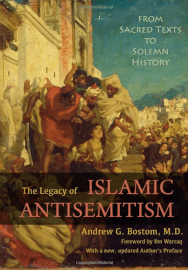
Andrew G. Bostom is the author of The Legacy of Jihad (Prometheus, 2005) and The Legacy of Islamic Antisemitism " (Prometheus, November, 2008) You can contact Dr. Bostom at @andrewbostom.net